Liberty Healing Quality
Therapeutic Sodalite Quality Parameters
Natural Sodalite spherical gems vary quite a bit in appearance. No two beads are alike. This variation should be kept in mind as you compare your necklace with our color and clarity criteria. Regardless of color grade, it is particularly important that a therapeutic-quality Sodalite necklace be comprised of spheres with consistent blue and white coloration throughout the necklace.
The consistent blue and white coloration gives the necklace a distinct character that expresses its own range of vibrations. Necklaces with too much variation in the beads’ color express a wide range of vibration that is unorganized and scattered. The more consistent the color, the more focused the necklace’s work can be. Collecting spheres of relatively consistent color and clarity variation is challenging because Sodalite spheres vary so much. But we make the effort because we know that it will make a difference in the healing value of the final product.
You may be attracted to a lighter or darker variety of Sodalite, regardless of its color grade. Follow that attraction, because it will lead you to Sodalite that is more harmonious with you, and therefore more effective.
Color
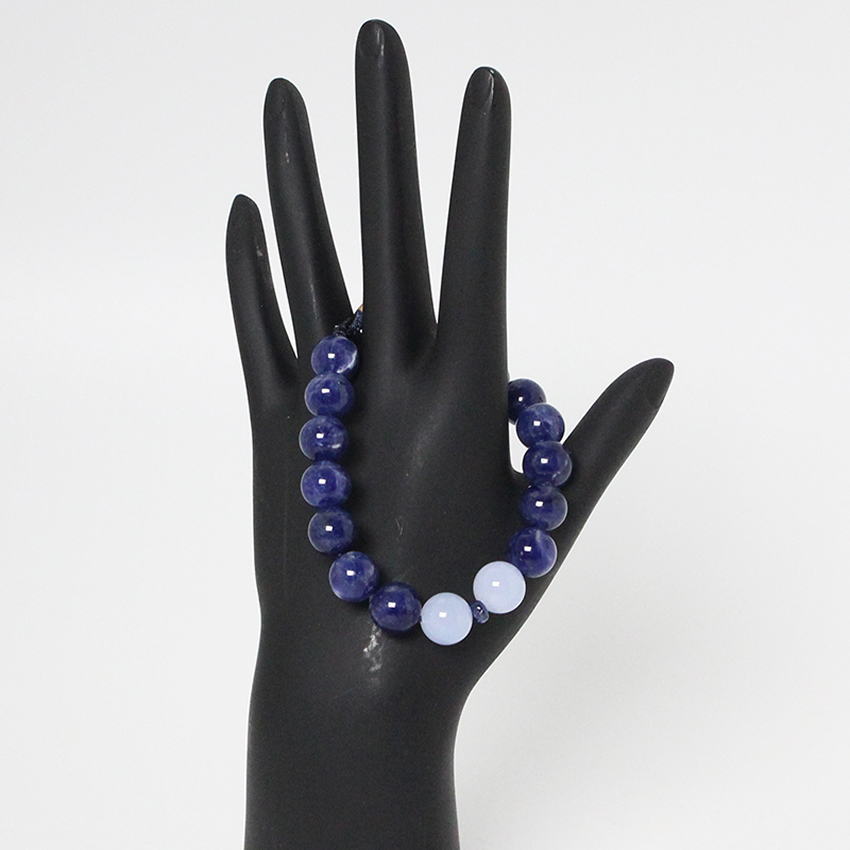
Therapeutic-quality Sodalite is a blue and white stone. It ranges in color from light to dark blue, and rarely may be violet-blue. It is free of color impurities such as yellows and reds. Sodalite naturally occurs with veins and patches of white, which are a therapeutically important part of the stone.
Our color rating focuses on the intensity of the blue coloration, which is caused by the presence of colloidal particles of metallic sodium in the Sodalite. The darker the color, the more sodium present in the stone.
5A color quality is awarded to bright, royal blue specimens.
4A color rankings are awarded to Sodalite that strays slightly from the ideal, either one way or the other; it’s typically a medium-light, denim color or a dark medium blue.
3A color quality is given to Sodalite whose color appears in a wider range. It may be a light denim blue or dark blue.
2A colors are either very light blue or indigo blue and are barely to somewhat therapeutic.
1A see 2A parameters.
Recently, Sodalite with a silvery gray sheen has become prevalent in the market. Based on tests performed by a G.I.A. certified gemologist, this shimmer is an optical phenomenon caused by the arrangement of Sodalite molecules. We usually find that optical phenomena like this support the healing properties of the gemstone, and this silvery sheen would do that too if it were blue. But we have only seen it in patches of gray or black Sodalite in an otherwise blue bead. Because the shiny gray Sodalite replaces the amount of healing blue Sodalite in the bead, we must consider it an inclusion.
Some gray sheen is acceptable if it doesn’t interfere with the overall blue appearance of the stone. A stone that appears overly gray does not have enough blue Sodalite to give you the desired healing benefits. A stone that has any amount of gray on it will not be given a grade higher than 3A.
Clarity
Sodalite is an opaque stone. We grade its clarity based on the quality of the white veins and patches that are a natural characteristic of Sodalite.
5A Sodalite contains minimal, well-defined, relatively equally distributed white veins or patches that do not overwhelm the blue coloration, which remains distinct.
4A Sodalite strays from the ideal, as it contains either fewer or more well-defined streaks or patches of white that may not be as well distributed, and the blue color is distinct.
3A Sodalite contains an even wider range of white veins and patches that have indistinct edges randomly distributed throughout the stone, or that may be pale or only visible up close under bright lighting. The blue color is obvious but may be tinted with white.
2A Sodalite has blotchy white patches or whiteness that overwhelms the stone.
1A See 2A parameters.
Candescence
Candescence relates to a gemstone’s interaction with light, and can include any special benefit-enhancing optical phenomena it displays. We generally grade Sodalite candescence 3A unless something about its shine or optical phenomenon is particularly special.
Gem-quality Sodalite, which is translucent and features white streaks, is rare to find and would be given a 4A or 5A rating depending on the degree of the translucency.
Cut
Our quality-grading criteria are based on the unique properties of each type of gemstone. Opalite, for example, has varying degrees of mineral hardness within any given bead. This makes it nearly impossible to cut into a perfect sphere, so a 3A-quality Opalite sphere may have minor bumps or dents, because that is “near perfect” for Opalite.
Sodalite is usually cut by machine, so our spheres are very well shaped when we receive them from the cutters. After inspecting every bead by hand in-house, we high-grade out every sphere we catch that has a divot, flat spot, or broken drill hole, or that isn’t quite perfectly round. Sodalite receives a 3A-quality cut rating due to its near-perfect shape when cut into spherical beads.


Reviews
There are no reviews yet.